Polymer Membrane Tensegrity
2024–2026
Images: Biomatter Lab / Ito, Shimoda, Fukunishi & Hayashi (arXiv:2608.30501) / Kuwada et al., Polymer Journal (2025, CC BY 4.0)
伊藤嵩人・下田悠太・福西遥佳(Biomatter Lab)
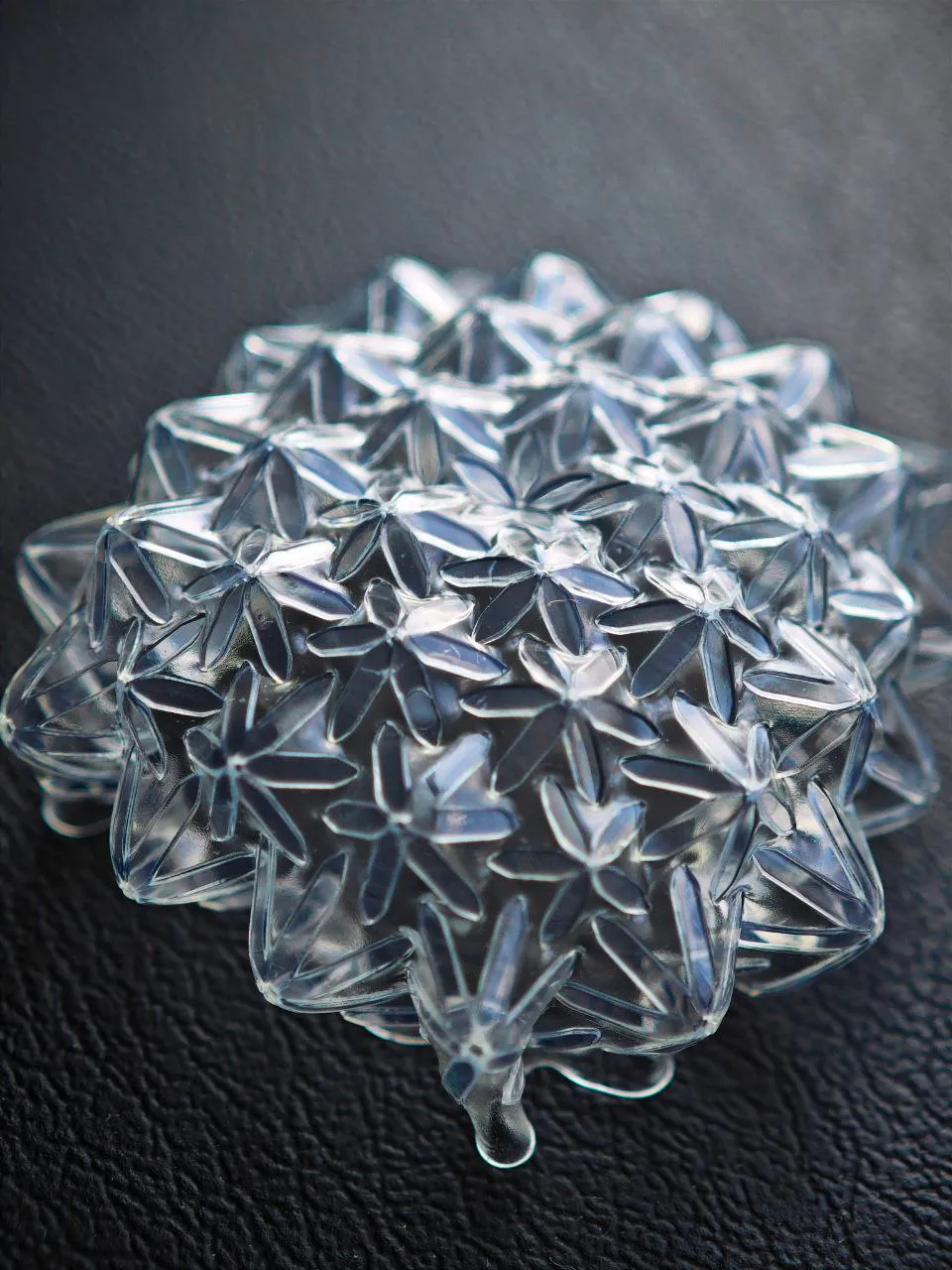
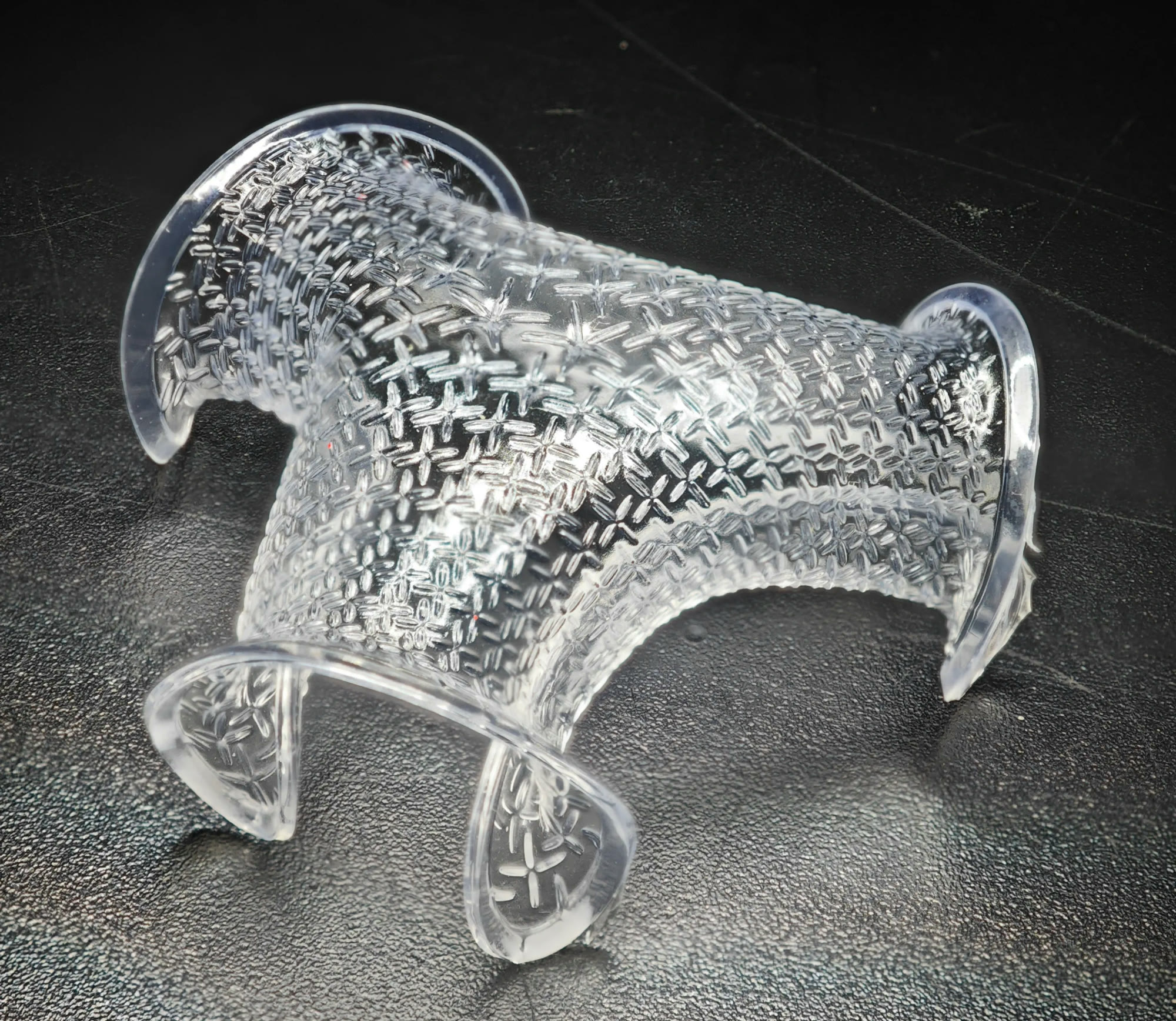
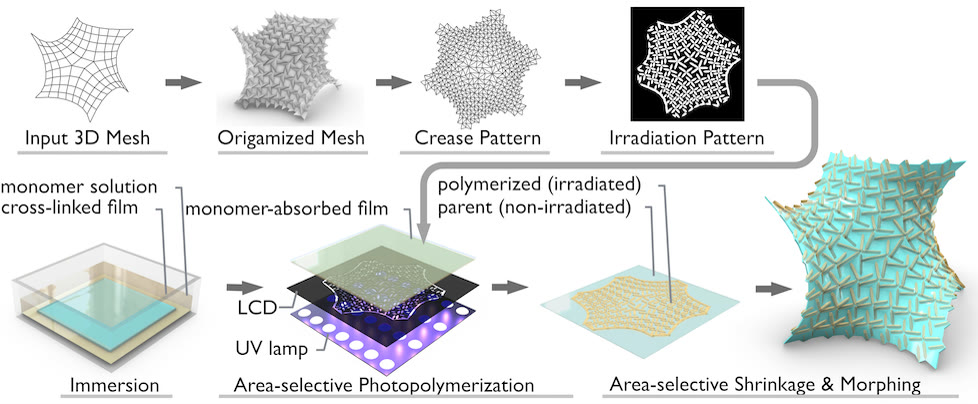
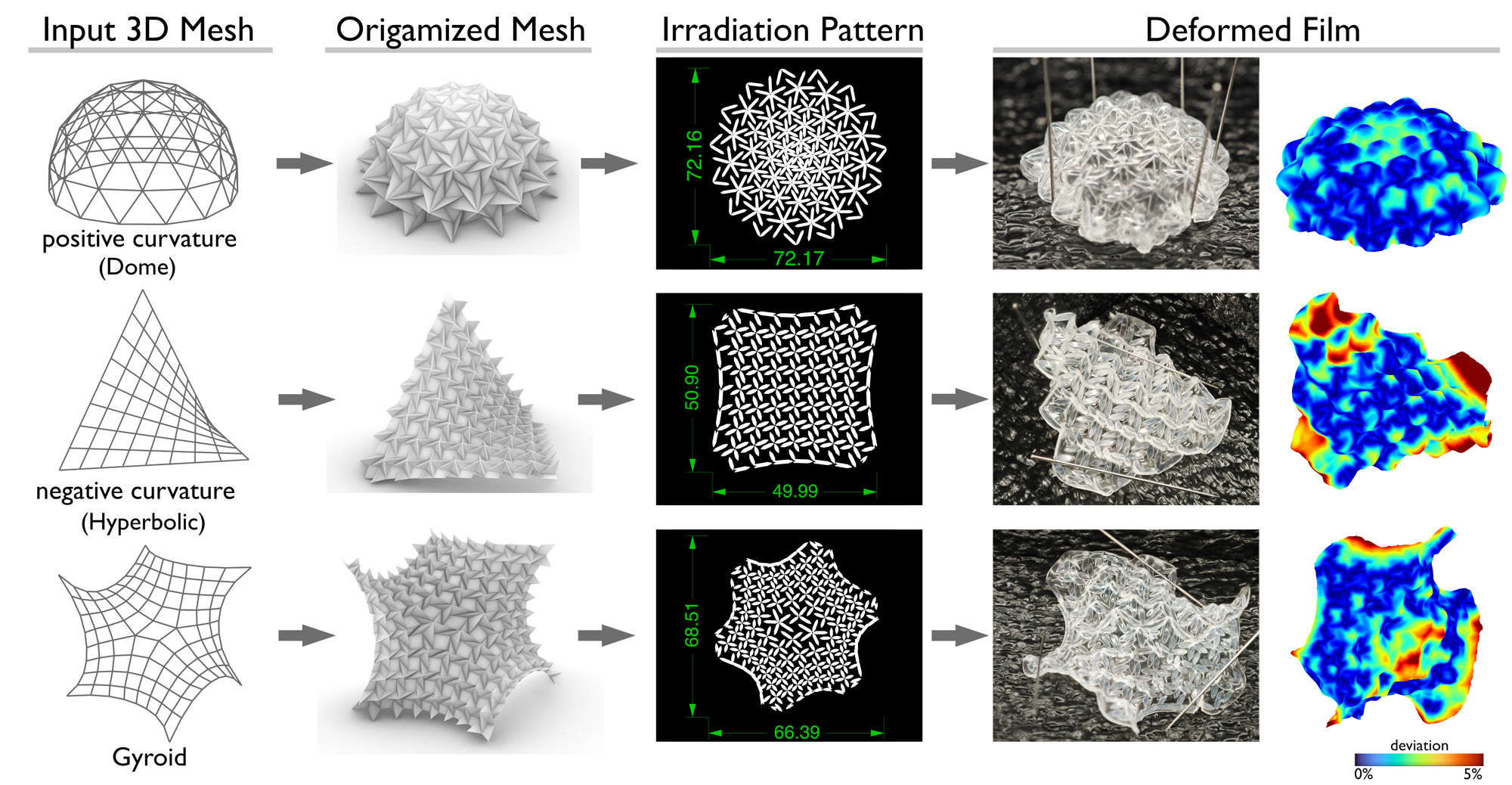
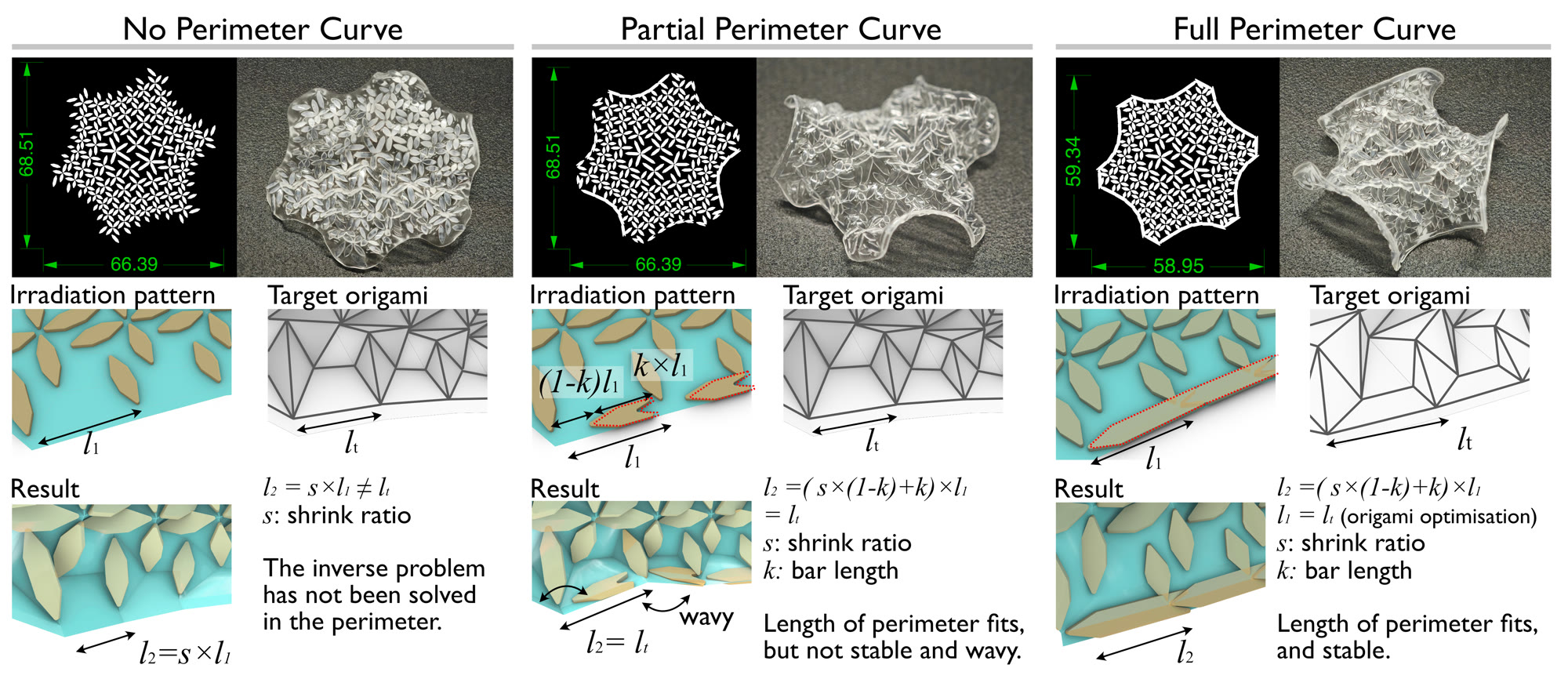
計算折紙と高分子化学の知見を組み合わせ、一枚のプラスチックフィルムから任意の3次元曲面を立ち上げる技術「Polymer Membrane Tensegrity」の研究。目標とする曲面を折紙の展開図に変換し、それをフィルムへの紫外線照射パターンに置き換えることで、平らなフィルムが自ら立体へと変形する。
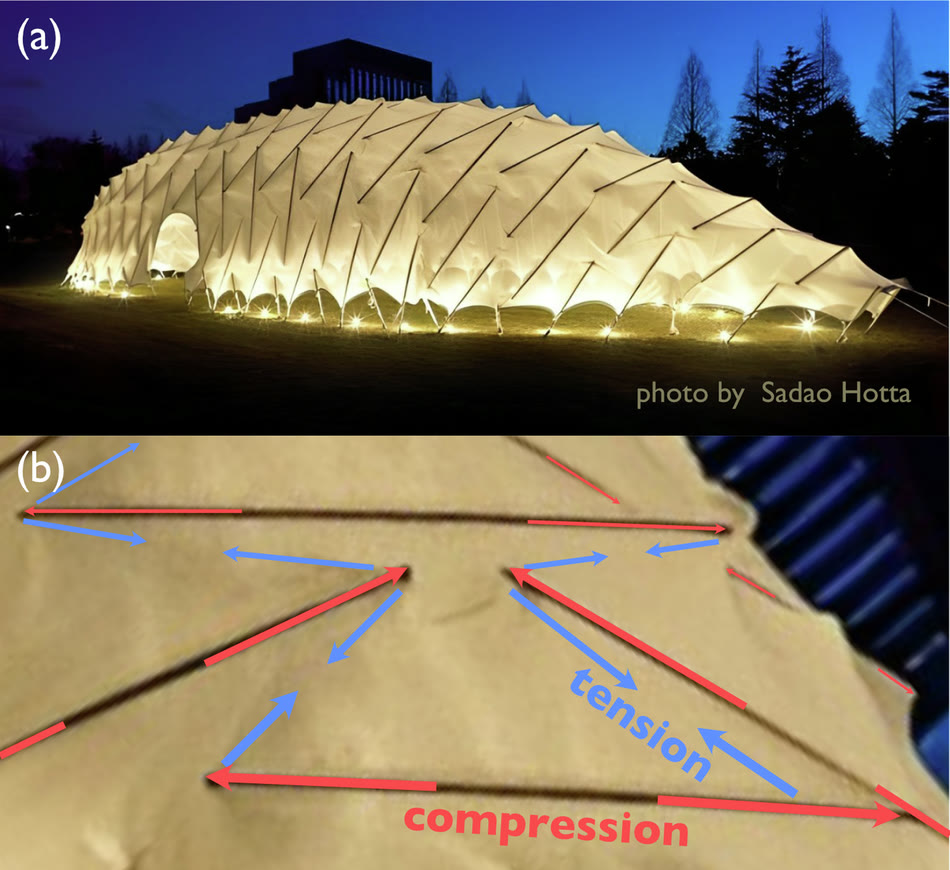
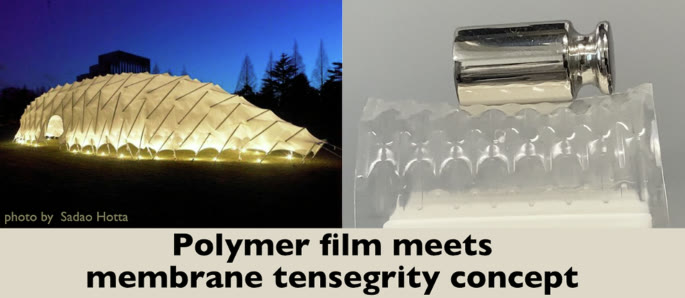
モノマー溶液を含ませたエラストマーフィルムに、LCDフォトマスクを通して紫外線を照射すると、照射された部分だけが硬い「棒」として重合する。乾燥させると、照射されていない膜は大きく縮み、棒はほとんど縮まない(収縮率の差は約50%、剛性の差は約2000倍)。この収縮差によって膜の張力と棒の圧縮力がつりあい、フィルムは膜テンセグリティ構造として立ち上がる。目標曲面から棒の配置を逆算する逆設計アルゴリズムにより、ドーム(正曲率)・双曲面(負曲率)・ジャイロイドといった曲面を、目標寸法に対して1〜2%程度の誤差で再現した。
「つながるかたち展04」(科学技術館、2024年10月5日〜27日)にて展示。関連論文:R. Kuwada ほか「Tensegrity-inspired polymer films: progressive bending stiffness through multipolymeric patterning」Polymer Journal 57, 587–594(2025)/伊藤・下田・福西・林「Polymer Membrane Tensegrity: Inverse Design of Polymer Films Morphing into Freeform 3D Surfaces with Digital Photopatterning Technique」arXiv:2608.30501(2026)。
Shuto Ito, Yuta Shimoda, Haruka Fukunishi (Biomatter Lab)
Research on "Polymer Membrane Tensegrity," a technique that combines computational origami with polymer chemistry to raise arbitrary freeform 3D surfaces from a single flat plastic film. A target surface is converted into an origami crease pattern, which is then translated into a UV irradiation pattern on the film, so that the flat sheet morphs into the 3D shape by itself.
An elastomer film swollen with a monomer solution is selectively UV-cured through an LCD photomask, so that only the irradiated regions polymerize into rigid "rods." On drying, the non-irradiated membrane shrinks far more than the rods (roughly a 50% strain differential and a 2,000-fold modulus contrast). Membrane tension and rod compression then balance, and the film rises as a membrane tensegrity structure. An inverse-design algorithm computes the rod layout from the target surface; domes (positive curvature), hyperbolic surfaces (negative curvature), and gyroid unit cells were reproduced with mean deviations of 1–2% of the target size.
Exhibited at CONNECTING ARTIFACTS 04 (Science Museum, Tokyo, October 5–27, 2024). Related papers: R. Kuwada, S. Ito, Y. Shimoda, H. Fukunishi, R. Ohnishi, D. Ishii & M. Hayashi, "Tensegrity-inspired polymer films: progressive bending stiffness through multipolymeric patterning," Polymer Journal 57, 587–594 (2025); S. Ito, Y. Shimoda, H. Fukunishi & M. Hayashi, "Polymer Membrane Tensegrity: Inverse Design of Polymer Films Morphing into Freeform 3D Surfaces with Digital Photopatterning Technique," arXiv:2608.30501 (2026).
Biomatter LabPolymer Journal (2025)arXiv (2026)CONNECTING ARTIFACTS 04
← Works