四面体凧 feat. Graham BellTetrahedral Kite feat. Graham Bell
2025
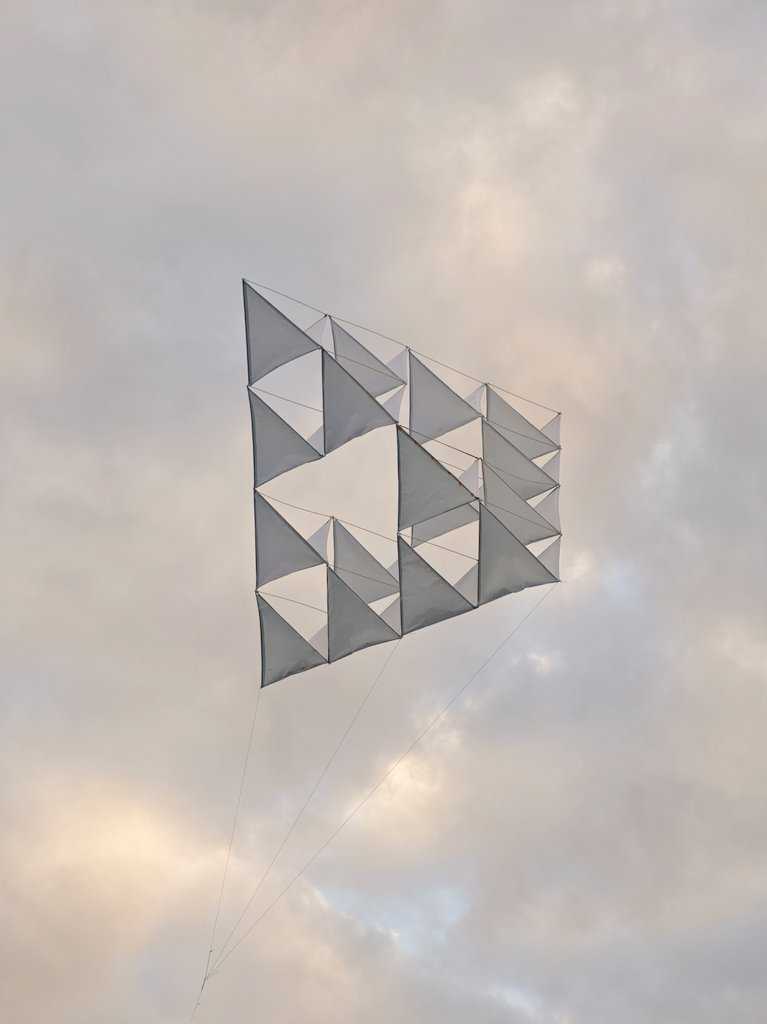
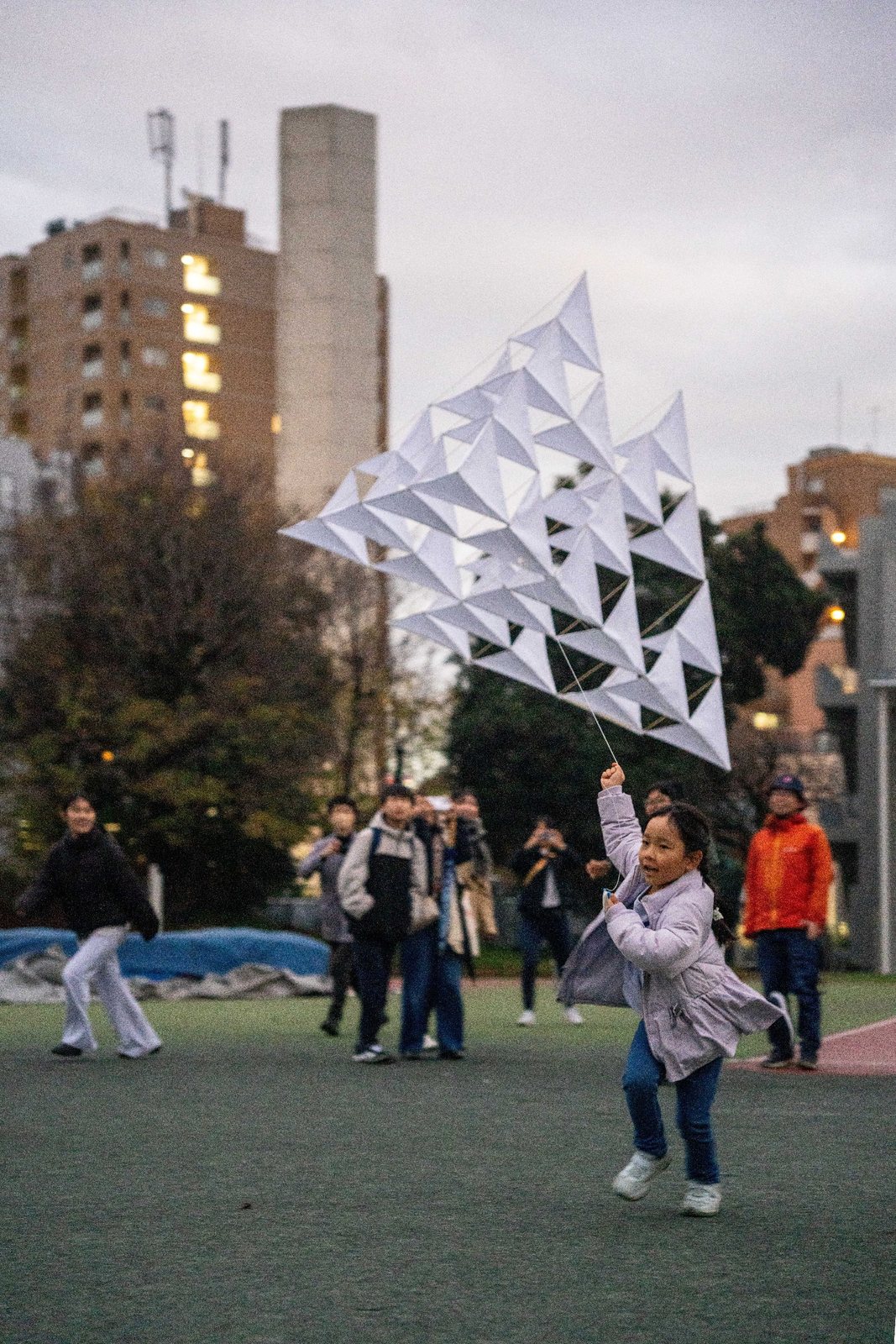
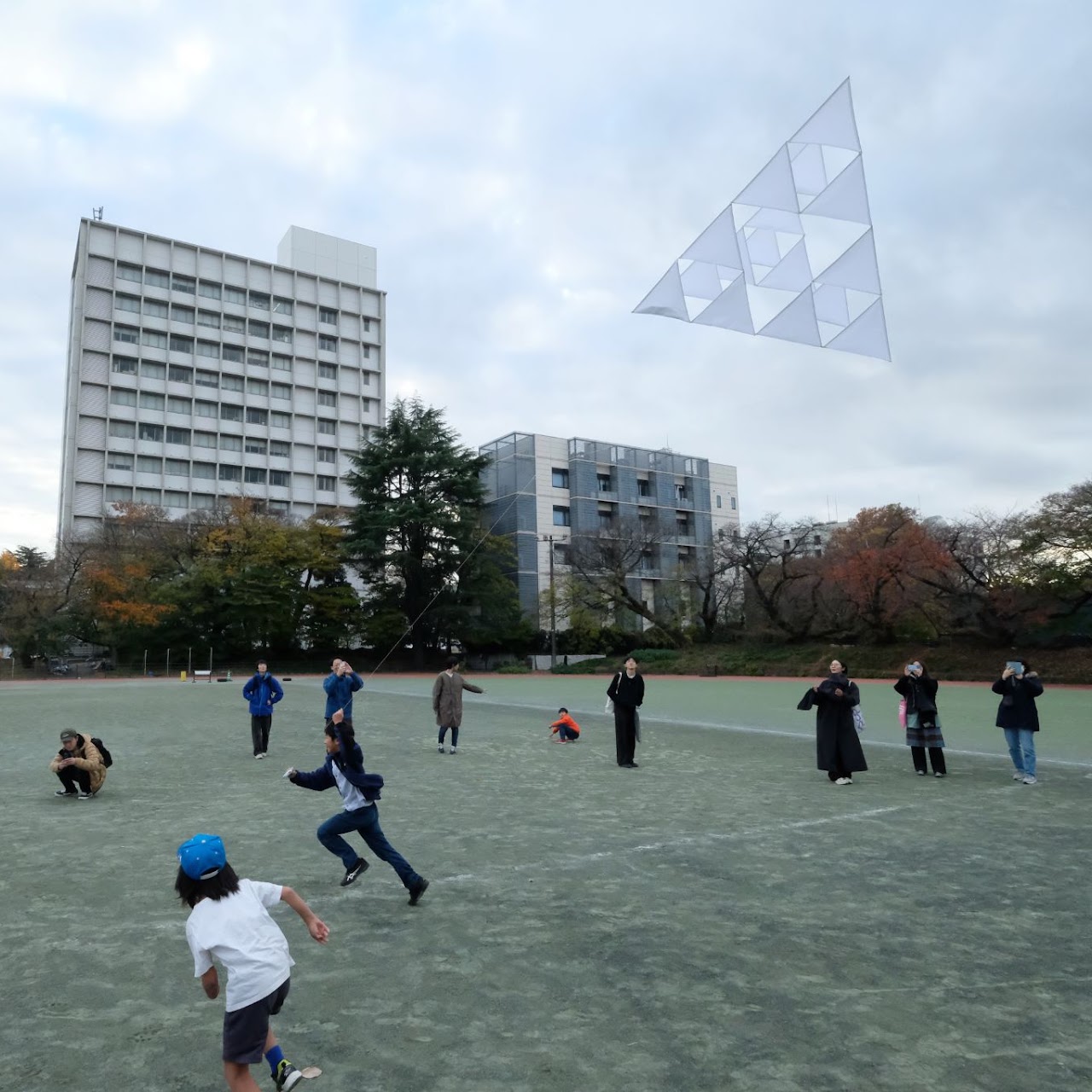
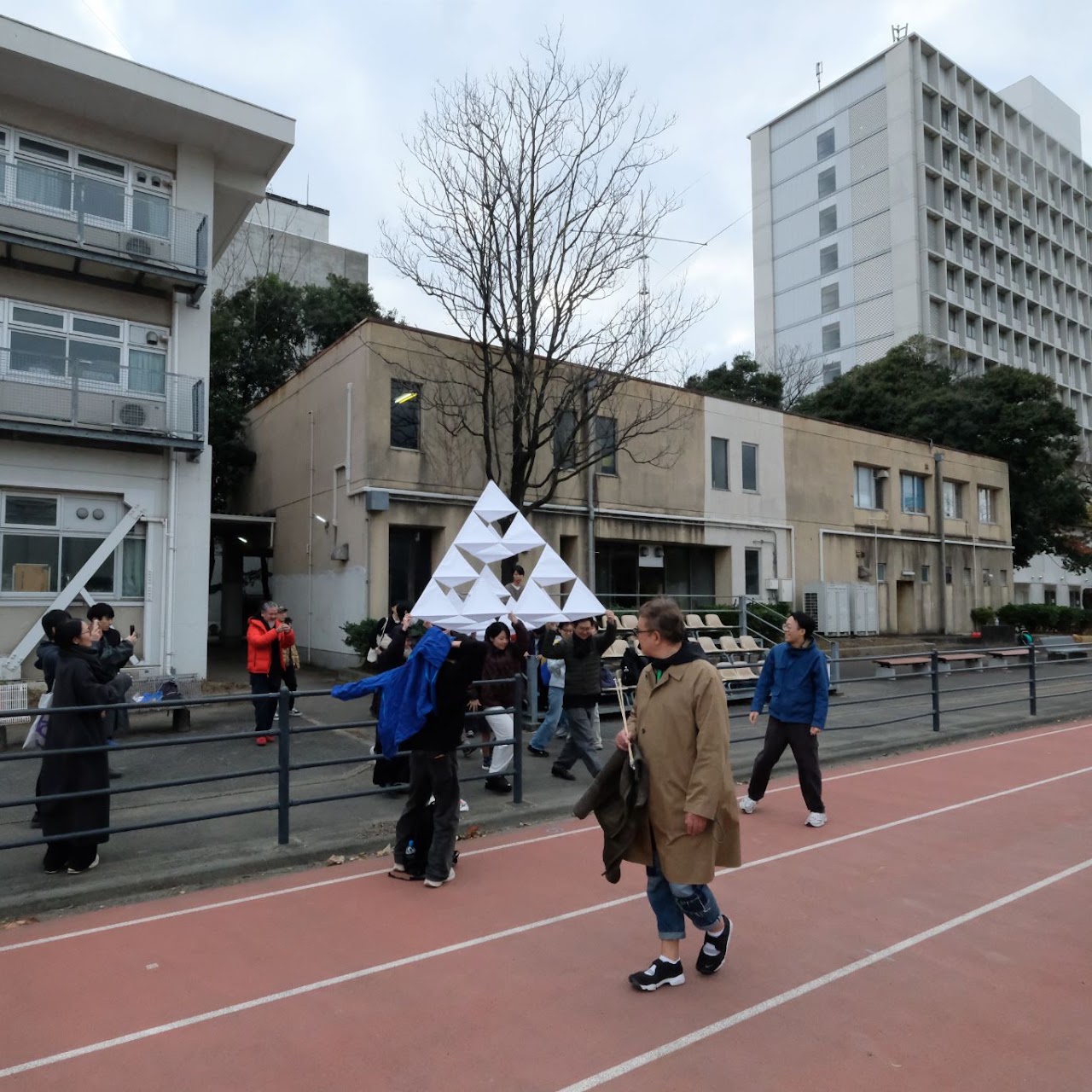
1・3–6:ワークショップ01(2025年11月29日、東京大学生産技術研究所)の16ユニット・一辺1.8mの凧/2:ワークショップ02(2025年12月14日、同)の64ユニット・一辺3.6mの凧1, 3–6: The 16-unit, 1.8 m kite at Workshop 01 (November 29, 2025, Institute of Industrial Science, The University of Tokyo) / 2: The 64-unit, 3.6 m kite at Workshop 02 (December 14, 2025, same venue)
下田悠太・藤堂真也/「そらとぶかたちワークショップ」(つながるかたち展05・06 関連企画)にて制作。第1回:2025年11月29日、第2回:2025年12月14日(いずれも東京大学生産技術研究所)、第3回:2026年8月29日(東京大学駒場キャンパス)
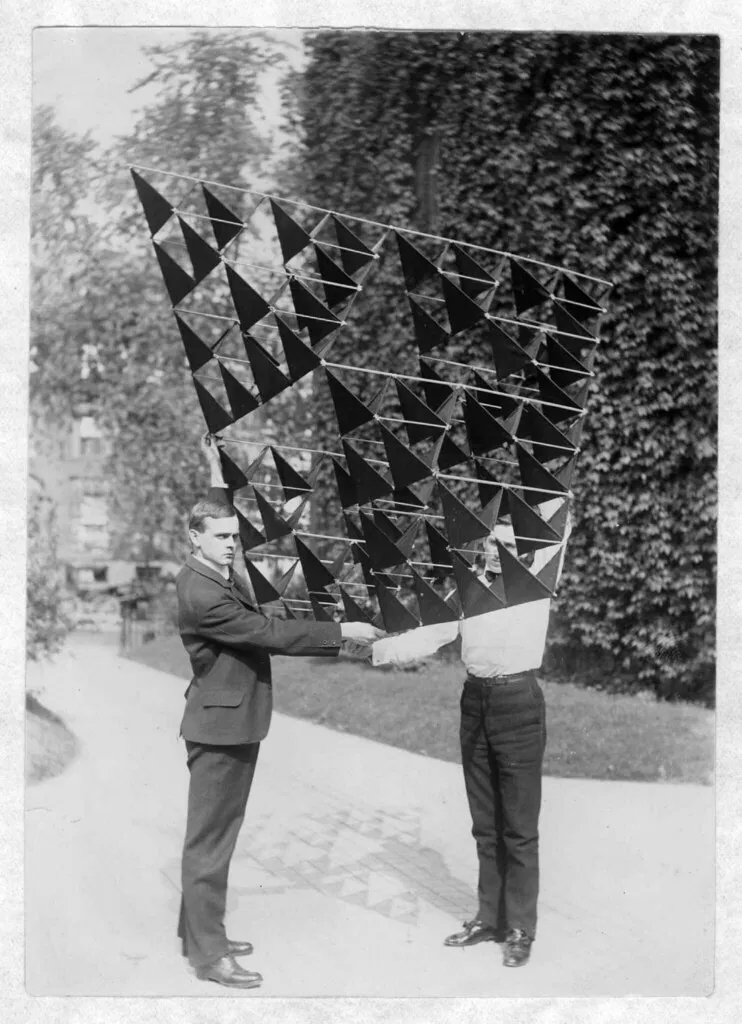
電話の発明者アレクサンダー・グラハム・ベルが約130年前に考案した「四面体凧」を、参加者とともに組み上げて空に飛ばすワークショップです。正四面体の骨組みに膜を張った小さなセルを4個組み合わせると一回り大きな正四面体になり、それをさらに4個組み合わせる——この入れ子(フラクタル)構造を繰り返して大きな凧をつくります。第1回では16個のユニットで一辺1.8m、第2回では64個のユニットで一辺3.6mの凧を、参加者全員の手で組み立て、屋外で飛行させました。
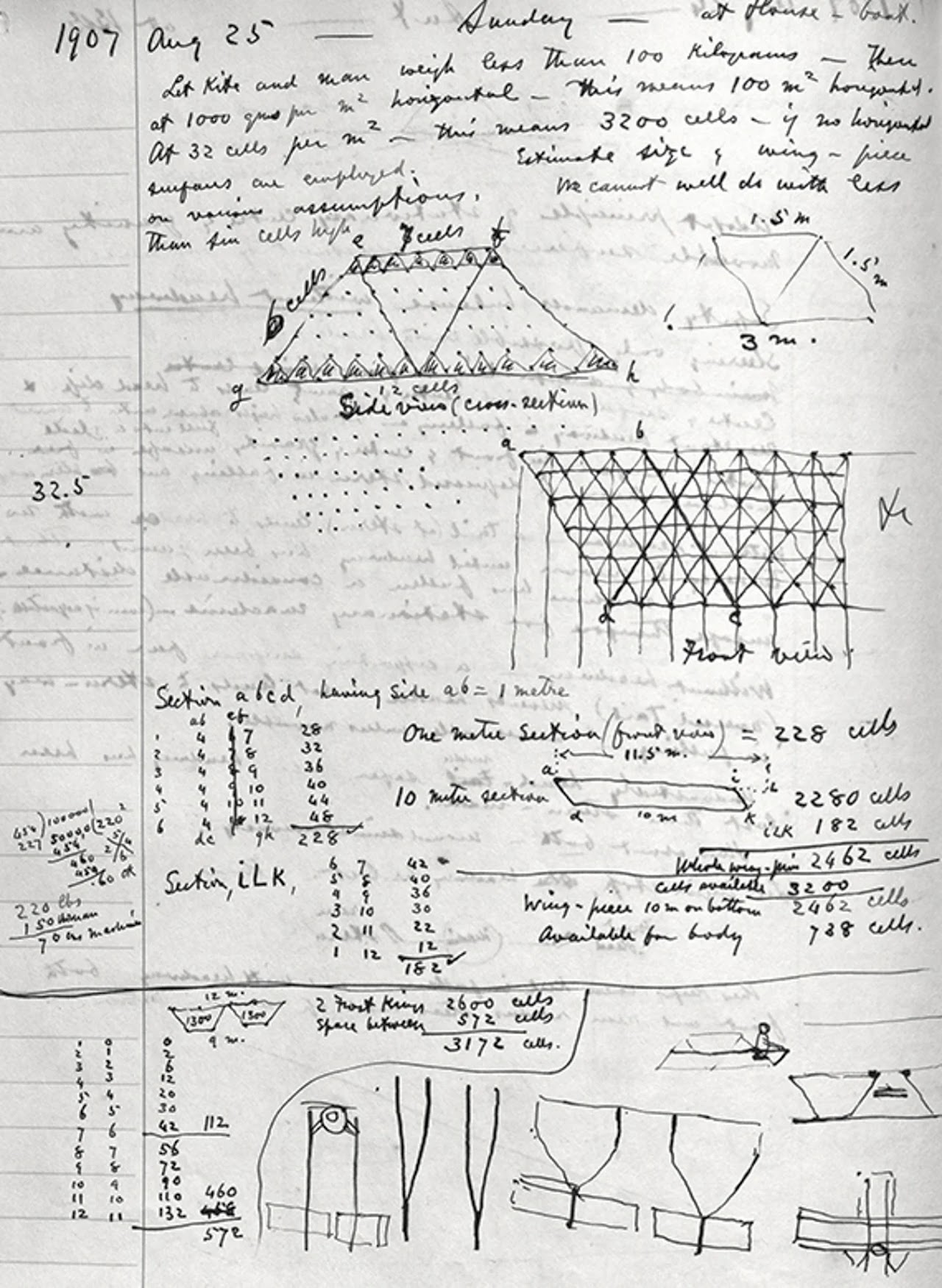
ふつうの凧は、大きくすると重量が寸法の三乗で増えるのに対して、揚力を生む面積は二乗でしか増えないため(二乗三乗則)、大型化に限界があります。ベルの四面体凧は、同じ大きさのセルを4個ずつ集めて一回り大きな四面体にしていくため、いくら大きくしても重量と膜面積の比が変わりません。小さな四面体をひとつ設計すれば、原理的にはいくらでも大きな凧をつくることができ、ベル自身は3,000個以上のセルからなる凧で人を空に上げました(1907年)。
材料は長さ450mmの竹ひごと圧着端子、結束バンド、薄い膜材だけです。竹ひごの両端に圧着端子をかしめ、頂点ごとに結束バンドで束ねると正四面体のユニットができ(1ユニット=竹ひご6本・圧着端子12個)、ユニット同士も結束バンドでつなぎます。道具はペンチだけという簡単な接合方法なので、初めての参加者や子どもでも組み立てられます。
ベルの四面体凧を出発点にした展開として、ベルの板金ジョイントを紙で再解釈した「四面体什器 feat. Graham Bell」や、一枚の紙から折り出す「POP-UP TREE」があります。
Yuta Shimoda, Masaya Todo / Built at the "Flying Artifacts Workshop", a companion program to CONNECTING ARTIFACTS 05 and 06. WS01: November 29, 2025 and WS02: December 14, 2025 (both at the Institute of Industrial Science, The University of Tokyo); WS03: August 29, 2026 (Komaba Campus, The University of Tokyo)
A workshop in which participants build and fly the "tetrahedral kite" devised roughly 130 years ago by Alexander Graham Bell, the inventor of the telephone. Four small cells — regular tetrahedral frames covered with a membrane — combine into a tetrahedron one size larger, and four of those combine again: repeating this nested (fractal) structure produces a large kite. In WS01, 16 units made a kite 1.8 m on a side; in WS02, 64 units made one 3.6 m on a side. Each was assembled by all of the participants and flown outdoors.
An ordinary kite cannot simply be scaled up: its weight grows with the cube of its dimensions while its lifting surface grows only with the square (the square–cube law). Bell's tetrahedral kite sidesteps this limit. Because identical cells are gathered four at a time into a tetrahedron one size larger, the ratio of weight to membrane area stays the same no matter how large the kite becomes. Design one small tetrahedron and, in principle, a kite of any size can be built — Bell himself lifted a person into the air with a kite of more than 3,000 cells (1907).
The only materials are 450 mm bamboo sticks, crimp terminals, cable ties and a thin membrane. Crimping a terminal onto each end of the sticks and binding them at each vertex with a cable tie produces one tetrahedral unit (6 sticks and 12 terminals per unit); units are joined to one another with cable ties as well. Since the only tool required is a pair of pliers, first-time participants and children can build it.
Two further works grew out of Bell's tetrahedral kite: the "Tetrahedral Modular System feat. Graham Bell", which reinterprets Bell's sheet-metal joint in paper, and "POP-UP TREE", folded from a single sheet of paper.
そらとぶかたちワークショップ 01Flying Artifacts Workshop 01そらとぶかたちワークショップ 02Flying Artifacts Workshop 02そらとぶかたちワークショップ 03Flying Artifacts Workshop 03Communities(ワークショップ紹介)Communities (about the workshop)四面体什器 feat. Graham BellTetrahedral Modular System feat. Graham BellPOP-UP TREE
← Works